Prizm
Web
B2B/B2C
Jan 2022 – Mar 2023
Role: Senior Product Designer — Design System Co-owner
Focus: Built the foundation for complex industrial UIs: geo-maps, data-viz, diagram editor.
Team Impact: Enabled consistent UI and faster delivery across teams with Figma + code parity.
Focus: Built the foundation for complex industrial UIs: geo-maps, data-viz, diagram editor.
Team Impact: Enabled consistent UI and faster delivery across teams with Figma + code parity.



More images in the Visual design section
Project overview
Prizm is an industrial design system for data-heavy operational software. It standardizes patterns, components, and complex UI behaviors to help teams ship consistent products faster.
Partners
Built in collaboration with PJSC “Gazprom Neft” and SE “Zyfra”.
Users
Operations, engineering, and production teams in industrial companies.
Where it’s used
Desktop apps · Web apps · Video walls · Workstations
Domains
Oil & gas · Metallurgy · Food production · Engineering
Distribution
Open-source, released under the MIT license.
Partners
Built in collaboration with PJSC “Gazprom Neft” and SE “Zyfra”.
Users
Operations, engineering, and production teams in industrial companies.
Where it’s used
Desktop apps · Web apps · Video walls · Workstations
Domains
Oil & gas · Metallurgy · Food production · Engineering
Distribution
Open-source, released under the MIT license.
Stakeholders
& needs
& needs
-
 DevelopersOptimized for implementation: tokens, states, and specs that match the codebase.
 -
 DesignersOptimized for speed: reusable patterns for complex modules (maps, data-viz, diagrams).
 -
 BusinessOptimized for scale: consistent UX across products and faster rollout of new solutions.
Key problems

- Faster delivery across products
Reduce rework and decision churn by reusing proven UI patterns and templates across teams. - Consistent UX for complex industrial tools
Unify visual language and interaction logic so maps, dashboards, and editors behave predictably in every product. - Design ↔ code parity
Align components, states, and tokens between Figma and the code library to improve quality and cut UI regressions.
My role
Senior Product Designer (Design System)
Jan 2022 – Mar 2023
Co-owned the design system from foundations to adoption. I helped shape the structure and rules early on, then led the component library and design→code quality.
What I owned
Team
Co-owned the design system from foundations to adoption. I helped shape the structure and rules early on, then led the component library and design→code quality.
What I owned
- Foundations: principles, structure, naming, component logic and states
- Component library: key UI patterns (incl. data-viz module) + documentation
- Design↔code parity: specs, reviews, QA of implemented components
- Adoption: workshops/demos and enablement for internal and external teams
Team
-
 Two Heads
of Design
Gazprom-Nef, Zyfra -
 Me
Me
Gazprom-Neft -
 Design & Dev pod
Team 1
Gazprom-Neft -
 Design & Dev pod
Team 2
Zyfra
Key Design Work
Industrial-first
principles
principles
Designed for high-risk, data-dense workflows (control rooms, operations, engineering). Prioritized clarity, error-prevention, and predictable behavior over “pretty UI”.
Component system
for complex states
for complex states
Built a scalable component library with strict state logic (defaults, errors, empty/loading, permissions). Reduced one-off design decisions and made behavior consistent across products.
Design ↔ code parity
Defined specs, naming, and tokens to match implementation. Reviewed builds and aligned edge cases so components in code behave like in Figma — not “close enough”.
Modular architecture
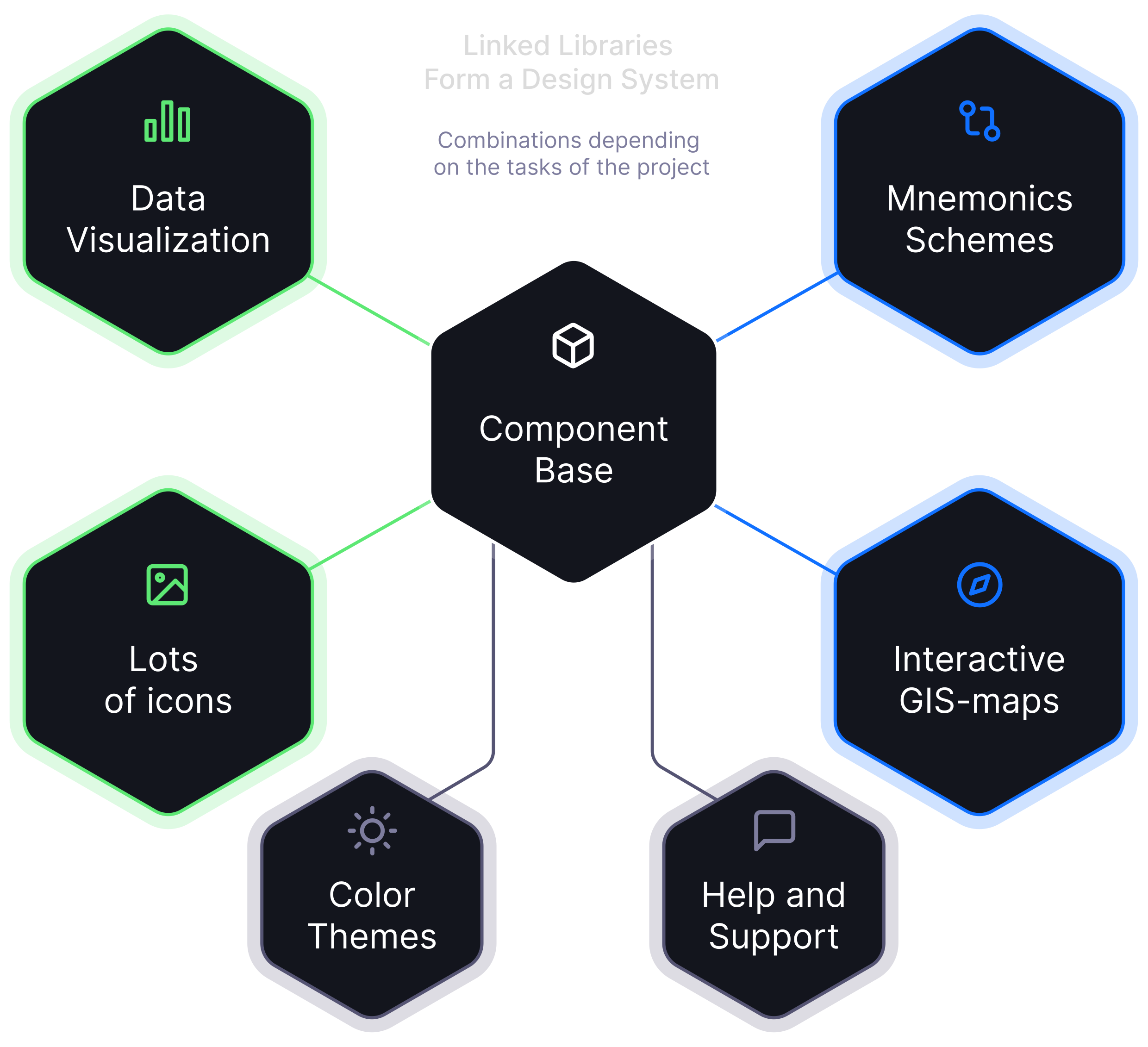
Split the system into modules (core UI, maps, diagrams, data-viz, theming). Teams could adopt what they need without dragging the whole system into every product.
Data visualization
for decisions
for decisions
Created decision-oriented chart patterns (comparisons, trends, thresholds, anomalies). Focused on readability and meaning — so operators can act fast, not interpret charts.
Delivered
- Core component libraryReusable UI kit in design + code, covering key patterns and complex states for industrial products.
- Data visualization moduleStandard chart patterns and rules for consistent, decision-ready analytics.
- Diagram constructorDiagram editor for industrial workflows (P&ID-style) to build and maintain process схемы.
- GIS maps moduleMapping toolkit for ops scenarios: layers, controls, and map-specific interactions.
- Documentation & usage rulesSpecs, examples, and usage rules to keep implementation consistent across teams.
- Light and dark theme, WCAGAccessible light/dark themes with token-based palettes for control-room environments.
- Future-proof modularityModular system that allows new patterns without breaking existing products.
- Icon libraryStructured icon set with clear naming and categories, readable across sizes.
Visual Design
Learn more about
design system components
design system components
The design system is distributed under the MIT license.
It is available for use in the public domain for any teams and industrial tasks.
It is available for use in the public domain for any teams and industrial tasks.
Opens in a new browser tab

Product outcomes
Confidentiality note: This case is numbers-free under strict corporate NDA; focus is on decisions and outcomes.
- More speedFaster product kickoff with reusable patterns and ready-to-implement components — less reinventing UI from scratch.
- Adopted by teamsShared system used across multiple cross-functional teams and products, including complex modules (maps, diagrams, data-viz).
- Less costLower rework and coordination overhead thanks to design↔code parity, clear specs, and predictable component behavior.
- Product qualityMore consistent UX and fewer UI regressions with standardized states, accessibility-ready themes, and a unified asset library.
My personal impact
& Key achievements
& Key achievements
Co-owned Prizm — an industrial design system for data-heavy products. Delivered foundations, production-ready libraries, and adoption support across teams.

Delivery ownership
Learned: systems scale through rules, not just components.
Handled: set contribution/review flow, wrote usage docs, and ran demos/workshops to drive adoption.
Handled: set contribution/review flow, wrote usage docs, and ran demos/workshops to drive adoption.
Design ↔ Code parity
Learned: trust comes from matching behavior, states, and tokens.
Handled: defined tokens + state logic, reviewed implementations, and QA’d edge cases to reduce UI regressions.
Handled: defined tokens + state logic, reviewed implementations, and QA’d edge cases to reduce UI regressions.
Complex modules ownership
Learned: complex domains need modular patterns.
Handled: led reusable patterns for maps/GIS, data-viz, and diagram workflows, plus themes (light/dark) and shared icon/assets set.
Handled: led reusable patterns for maps/GIS, data-viz, and diagram workflows, plus themes (light/dark) and shared icon/assets set.
Other Cases


Jun 2023 – Jul 2025 B2C
Role: Senior Product Designer — research, UX/UI, experiments
Focus: Redesigned marine weather tools and decision workflows; built continuous hypothesis pipeline with product team.
Team Impact: Improved activation and retention via UX/UI upgrades and experiments.
Role: Senior Product Designer — research, UX/UI, experiments
Focus: Redesigned marine weather tools and decision workflows; built continuous hypothesis pipeline with product team.
Team Impact: Improved activation and retention via UX/UI upgrades and experiments.


Jun 2023 – Jul 2025 B2C
Role: Senior Product Designer — discovery, UX/UI, experiments
Focus: Designed data-dense marine weather interface, segmentation model and core map interactions.
Team Impact: 3.4× growth of active paid users, 2× retention improvement, 20+ validated experiments.
Role: Senior Product Designer — discovery, UX/UI, experiments
Focus: Designed data-dense marine weather interface, segmentation model and core map interactions.
Team Impact: 3.4× growth of active paid users, 2× retention improvement, 20+ validated experiments.


Jul 2025 – Nov 2025 B2C, build on public
Role: Solo Product Designer and owner
Focus: Designed a system of 186+ widgets, themes and mini-apps; created a tiny theme editor; shipped full visual language and interaction model.
Solo Impact: Independently delivered a full product lifecycle: market analysis, research, UX/UI, prototyping, development and App Store launch.
Role: Solo Product Designer and owner
Focus: Designed a system of 186+ widgets, themes and mini-apps; created a tiny theme editor; shipped full visual language and interaction model.
Solo Impact: Independently delivered a full product lifecycle: market analysis, research, UX/UI, prototyping, development and App Store launch.


Feb 2022 – Oct 2022 B2B
Role: Product Designer — UX/UI for complex B2B data workflows
Focus: Designed data search and analysis experience; simplified workflows and information architecture.
Team Impact: Improved data discovery speed for analysts by ~30–40%, depending on scenario.
Role: Product Designer — UX/UI for complex B2B data workflows
Focus: Designed data search and analysis experience; simplified workflows and information architecture.
Team Impact: Improved data discovery speed for analysts by ~30–40%, depending on scenario.


Aug 2021 – Feb 2022 B2B
Role: Product Designer — UX/UI for trading flows
Focus: Designed product search, selling flow and trading network interactions.
Team Impact: Reduced friction in transaction flow and increased conversion.
Role: Product Designer — UX/UI for trading flows
Focus: Designed product search, selling flow and trading network interactions.
Team Impact: Reduced friction in transaction flow and increased conversion.


Mar 2020 – Jan 2022 B2B
Role: Product Designer — navigation and safety interfaces
Focus: Designed navigation dashboards, weather layers and emergency response flows.
Team Impact: Reduced time-to-decision for captains by improving clarity of critical information.
Role: Product Designer — navigation and safety interfaces
Focus: Designed navigation dashboards, weather layers and emergency response flows.
Team Impact: Reduced time-to-decision for captains by improving clarity of critical information.


Mar 2020 – Aug 2021 B2B
Role: Product Designer — UX/UI for geospatial threat tools
Focus: Designed ice-threat prediction maps and route-safety visualization tools.
Team Impact: Improved clarity of risk zones and reduced decision time in safety-critical scenarios.
Role: Product Designer — UX/UI for geospatial threat tools
Focus: Designed ice-threat prediction maps and route-safety visualization tools.
Team Impact: Improved clarity of risk zones and reduced decision time in safety-critical scenarios.


Jun 2018 – Jan 2019 B2C
Role: Product Designer — UX/UI for marketplace flows
Focus: Designed end-to-end flows connecting furniture studios and suppliers; built mobile and web experiences.
Team Impact: Improved conversion and simplified multi-step purchase/renovation journeys.
Role: Product Designer — UX/UI for marketplace flows
Focus: Designed end-to-end flows connecting furniture studios and suppliers; built mobile and web experiences.
Team Impact: Improved conversion and simplified multi-step purchase/renovation journeys.


Jun 2018 — Sep 2024
Role: Designer / Developer / R&D
Focus: AR experiments, custom design tools, interaction prototypes and design system explorations.
Solo Impact: Strengthened technical versatility and experimentation skills beyond core product work.
Role: Designer / Developer / R&D
Focus: AR experiments, custom design tools, interaction prototypes and design system explorations.
Solo Impact: Strengthened technical versatility and experimentation skills beyond core product work.
