
Arctic Captain
Web SaaS
B2B
Mar 2020 – Jan 2022
Role: Product Designer — end-to-end UX for Arctic fleet operations (web + mobile).
Focus: Complex geo-data UX: routes, constraints, alerts, offline/poor signal scenarios, cross-role workflows.
Team Impact: Shipped a reliable ops toolkit used daily; improved usability of critical map workflows and reporting
Focus: Complex geo-data UX: routes, constraints, alerts, offline/poor signal scenarios, cross-role workflows.
Team Impact: Shipped a reliable ops toolkit used daily; improved usability of critical map workflows and reporting



More images in the Visual design section
Operational context
Problem
Arctic navigation requires fast, high-stakes decisions with incomplete data and unstable connectivity.
Users
Captains & onboard crew · Dispatchers / fleet operators · Port / station staff
What we built
A single ops platform that combines: route planning, map-based hazard layers (ice/weather/depth), vessel status, incident alerts, and automated reporting.
Where it’s used
Desktop · Tablet · Mobile · Operations video walls
Arctic navigation requires fast, high-stakes decisions with incomplete data and unstable connectivity.
Users
Captains & onboard crew · Dispatchers / fleet operators · Port / station staff
What we built
A single ops platform that combines: route planning, map-based hazard layers (ice/weather/depth), vessel status, incident alerts, and automated reporting.
Where it’s used
Desktop · Tablet · Mobile · Operations video walls

Designing for the Arctic
Safety-critical
Navigation choices directly impact safety and schedule.
Real-time operations
Ice, weather, and traffic shift constantly—updates must be instant.
Data-heavy
Multiple map layers and sensors. Signals must be readable at a glance.
Multi-team coordination
Crew, dispatch, and ports act together and need a shared picture.
Design challenges
Primary user:
Vessel crew navigating through weak ice in northern seas. Transporting cargo with the risk of collisions with ice.
Vessel crew navigating through weak ice in northern seas. Transporting cargo with the risk of collisions with ice.


- Modular map for multiple roles
One map framework with switchable layers and tools for captains, dispatchers, and ports. - Faster decisions in risky situations
Detect threats early and guide the next action: reroute, adjust schedule, notify stakeholders. - Role-based dashboards
KPI + context in one place to understand the situation now and what’s likely next. - Reduce operational friction
Minimize manual inputs and handoffs: auto-capture events into reports, consistent statuses across teams.
Fragmented sources, delayed updates, uncertain ETA.
One operational picture, faster coordination.
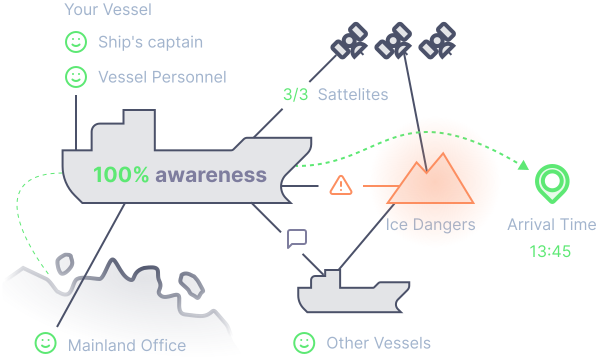

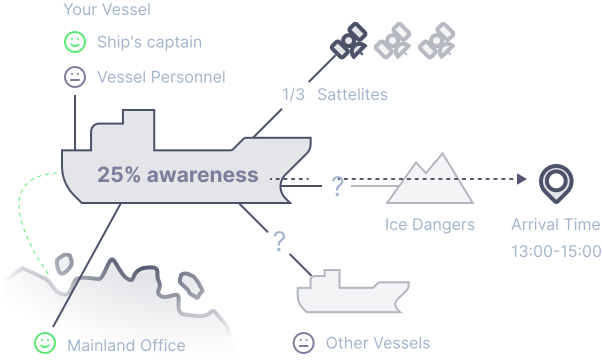
Before
After
My role & ownership
Product Designer (Mid-level)
Sep 2018 — Jan 2021
What I did
Team
What I did
- Audited the existing system and defined UX gaps (threats, routing context, reporting).
- Worked with domain experts to translate navigation workflows into product tasks.
- Built prototypes and supported user testing with captains and business/ops roles (with a UX researcher).
- Shipped new interfaces for maps, vessel status, and reporting basics.
Team
-
 Head of Design
 -
 Me
Me -
 UX Researcher
Senior Product Designer
Jan 2021 — Dec 2021
What changed after promotion
Team
What changed after promotion
- Led UX for safety-critical scenarios: detect → assess → decide → notify.
- Standardized map layers/states and scaled UI patterns across modules.
- Designed dashboards for captains and shore ops to reduce manual coordination.
- Improved reporting flows to reduce routine work and increase data consistency.
Team
-
 Head of Design
 -
 Me
Me -
 Product Designer
 -
 Junior Designer
Workflow
Domain & onboarding
Goal: Learn Arctic ops constraints
Output: Roles + key scenarios, initial backlog, map layer taxonomy
My part:
Defined UI requirements and first clickable flows
Output: Roles + key scenarios, initial backlog, map layer taxonomy
My part:
Defined UI requirements and first clickable flows
Validation with users
Goal: Validate critical flows
Output: Findings, UX risk list, updated flows and IA
My part:
Built testable prototypes, ran iterations, synthesized changes
Output: Findings, UX risk list, updated flows and IA
My part:
Built testable prototypes, ran iterations, synthesized changes
End-to-end prototype
Goal: Align on the “single operational picture”
Output: Interactive prototype across core roles and scenarios
My part:
Owned map framework, threat-to-action flow, dashboard structure
Output: Interactive prototype across core roles and scenarios
My part:
Owned map framework, threat-to-action flow, dashboard structure
UI system & production design
Goal: Ship consistent data-heavy UI
Output: Components, states, theming, final specs
My part:
Designed key screens, standardized patterns, maintained quality
Output: Components, states, theming, final specs
My part:
Designed key screens, standardized patterns, maintained quality
Build, QA, iteration
Goal: Reduce implementation gaps
Output: Dev specs, review cycles, fixes from feedback
My part:
Design QA, edge cases, engineer sync, post-release improvements
Output: Dev specs, review cycles, fixes from feedback
My part:
Design QA, edge cases, engineer sync, post-release improvements
Discovery
and validation
and validation
Immersion
Goal: Learn Arctic ops constraints (safety, connectivity, coordination)
Output: Captain/shore roles, key scenarios, map layer taxonomy, initial backlog
Decision: MVP focus: situational awareness + routing + reporting basics
Output: Captain/shore roles, key scenarios, map layer taxonomy, initial backlog
Decision: MVP focus: situational awareness + routing + reporting basics
Prototyping
Goal: Make safety-critical flows testable on the map
Output: Clickable prototypes for route planning, threat detection, reporting
Decision: Which map interactions/states work under pressure
Output: Clickable prototypes for route planning, threat detection, reporting
Decision: Which map interactions/states work under pressure
User Story Map
Goal: Align scope across captains and shore ops
Output: USM + release sequence for map, dashboards, reporting
Decision: What ships first to support real voyages
Output: USM + release sequence for map, dashboards, reporting
Decision: What ships first to support real voyages
Validation sessions
Goal: Validate decisions with captains and shore ops
Output: Findings + severity, updated map flows and IA
Decision: What to iterate before build; what to standardize into UI patterns**
Output: Findings + severity, updated map flows and IA
Decision: What to iterate before build; what to standardize into UI patterns**
Visual system
challenges
challenges
Goal: safety-first visuals for data-heavy maps (clarity, consistency, low cognitive load)
-
 One screen, many signals
Combine map layers, vessel status, and alerts without losing focus. -
 Works for different operators
Designed for varying experience levels and hardware setups. -
 Consistent map semantics
Standard symbols for locations, routes, and threats to prevent misreading. -
 Day / night readability
Themes for polar night and bright conditions, contrast-first. -
 Threat visuals that scale
A clear severity model and states aligned with maritime conventions. -
 Extensible system
Patterns and components that support future modules without redesign.
Product outcomes
Confidentiality note: This case is numbers-free under strict corporate NDA; focus is on decisions and outcomes.
-
 Standardized threat languageCreated a shared model for warnings and threats across roles: symbols, severity, and states. Reused as a baseline for other modules.
 -
 Ops dashboard / command centerA consolidated view of fleet status, KPIs, and incidents—so operators can act without switching screens.
 -
 Configurable interactive map
- Layer presets with safe defaults
- Object catalog (vessels, routes, hazards)
- Route planning with alternatives + tracking
- Unified legend + threat layers (incl. coastal warnings)
My personal impact
& Key achievements
& Key achievements
I helped turn Arctic navigation constraints into a usable ops product. Owned the map framework, threat-to-action UX, and role-based dashboards from discovery to release.

Owning under constraints
Learned: experts don’t need “UI”—they need risk reduction.
Handled: scoped unknowns early, surfaced UX risks, and shipped in tight iterations with clear reviews.
Handled: scoped unknowns early, surfaced UX risks, and shipped in tight iterations with clear reviews.
Map UX system thinking
Learned: maps are state machines, not screens.
Handled: built reusable patterns and states for consistent decisions under low signal and time pressure.
Handled: built reusable patterns and states for consistent decisions under low signal and time pressure.
From threat to action
Learned: value appears only when insight becomes the next step.
Handled: designed the assess → mark → alert → handoff flow, aligned teams, and protected quality with specs + QA.
Handled: designed the assess → mark → alert → handoff flow, aligned teams, and protected quality with specs + QA.
Other Cases


Jun 2023 – Jul 2025 B2C
Role: Senior Product Designer — research, UX/UI, experiments
Focus: Redesigned marine weather tools and decision workflows; built continuous hypothesis pipeline with product team.
Team Impact: Improved activation and retention via UX/UI upgrades and experiments.
Role: Senior Product Designer — research, UX/UI, experiments
Focus: Redesigned marine weather tools and decision workflows; built continuous hypothesis pipeline with product team.
Team Impact: Improved activation and retention via UX/UI upgrades and experiments.


Jun 2023 – Jul 2025 B2C
Role: Senior Product Designer — discovery, UX/UI, experiments
Focus: Designed data-dense marine weather interface, segmentation model and core map interactions.
Team Impact: 3.4× growth of active paid users, 2× retention improvement, 20+ validated experiments.
Role: Senior Product Designer — discovery, UX/UI, experiments
Focus: Designed data-dense marine weather interface, segmentation model and core map interactions.
Team Impact: 3.4× growth of active paid users, 2× retention improvement, 20+ validated experiments.


Jul 2025 – Nov 2025 B2C, build on public
Role: Solo Product Designer and owner
Focus: Designed a system of 186+ widgets, themes and mini-apps; created a tiny theme editor; shipped full visual language and interaction model.
Solo Impact: Independently delivered a full product lifecycle: market analysis, research, UX/UI, prototyping, development and App Store launch.
Role: Solo Product Designer and owner
Focus: Designed a system of 186+ widgets, themes and mini-apps; created a tiny theme editor; shipped full visual language and interaction model.
Solo Impact: Independently delivered a full product lifecycle: market analysis, research, UX/UI, prototyping, development and App Store launch.


Feb 2022 – Oct 2022 B2B
Role: Product Designer — UX/UI for complex B2B data workflows
Focus: Designed data search and analysis experience; simplified workflows and information architecture.
Team Impact: Improved data discovery speed for analysts by ~30–40%, depending on scenario.
Role: Product Designer — UX/UI for complex B2B data workflows
Focus: Designed data search and analysis experience; simplified workflows and information architecture.
Team Impact: Improved data discovery speed for analysts by ~30–40%, depending on scenario.


Aug 2021 – Feb 2022 B2B
Role: Product Designer — UX/UI for trading flows
Focus: Designed product search, selling flow and trading network interactions.
Team Impact: Reduced friction in transaction flow and increased conversion.
Role: Product Designer — UX/UI for trading flows
Focus: Designed product search, selling flow and trading network interactions.
Team Impact: Reduced friction in transaction flow and increased conversion.


Mar 2020 – Aug 2021 B2B
Role: Product Designer — UX/UI for geospatial threat tools
Focus: Designed ice-threat prediction maps and route-safety visualization tools.
Team Impact: Improved clarity of risk zones and reduced decision time in safety-critical scenarios.
Role: Product Designer — UX/UI for geospatial threat tools
Focus: Designed ice-threat prediction maps and route-safety visualization tools.
Team Impact: Improved clarity of risk zones and reduced decision time in safety-critical scenarios.


Jun 2018 – Jan 2019 B2C
Role: Product Designer — UX/UI for marketplace flows
Focus: Designed end-to-end flows connecting furniture studios and suppliers; built mobile and web experiences.
Team Impact: Improved conversion and simplified multi-step purchase/renovation journeys.
Role: Product Designer — UX/UI for marketplace flows
Focus: Designed end-to-end flows connecting furniture studios and suppliers; built mobile and web experiences.
Team Impact: Improved conversion and simplified multi-step purchase/renovation journeys.


Jan 2022 – Mar 2023 B2B/B2C
Role: Product Designer / Design System Owner
Focus: Built a scalable design system for industrial solutions — components, interactions and dev-ready documentation.
Team Impact: Accelerated delivery of new products and reduced design–dev inconsistencies.
Role: Product Designer / Design System Owner
Focus: Built a scalable design system for industrial solutions — components, interactions and dev-ready documentation.
Team Impact: Accelerated delivery of new products and reduced design–dev inconsistencies.


Jun 2018 — Sep 2024
Role: Designer / Developer / R&D
Focus: AR experiments, custom design tools, interaction prototypes and design system explorations.
Solo Impact: Strengthened technical versatility and experimentation skills beyond core product work.
Role: Designer / Developer / R&D
Focus: AR experiments, custom design tools, interaction prototypes and design system explorations.
Solo Impact: Strengthened technical versatility and experimentation skills beyond core product work.
